

Rakour
Menu
Commercial Battery Storage Systems Built for Factory-Scale Power Demands

High Voltage Energy Storage Solutions for Industrial Facilities

Commercial Battery Storage Systems Built for Factory-Scale Power Demands

Rakour's high-voltage LiFePO4 BESS helps factories cut peak demand charges, ensure backup power, and integrate solar — scalable from 40kWh to multi-MW.

Factory Energy Storage: What It Is & Why It Matters

High-performance commercial battery storage purpose-built for manufacturing environments

What Is a Factory Battery Energy Storage System?

A factory battery energy storage system stores grid or solar electricity during off-peak hours and releases it during production peaks. Rakour's high-voltage LiFePO4 BESS operates at 232V–979V, delivering stable, scalable power across heavy industrial loads without equipment upgrades.
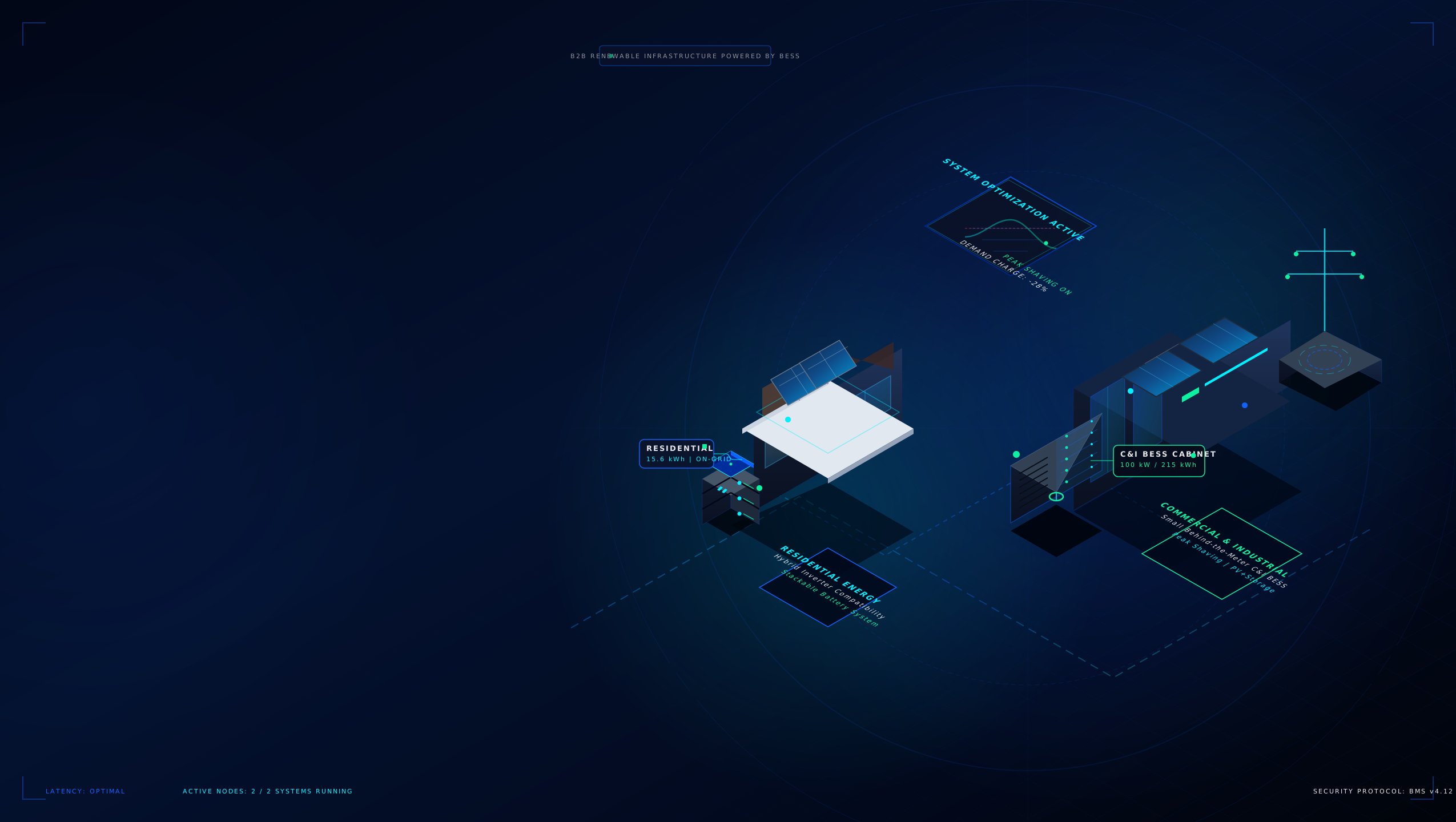
Who Needs Industrial Battery Storage?

Manufacturing plants, assembly facilities, and process industries with peak demand charges exceeding 30% of monthly utility bills. If your production lines draw sudden high loads or your site runs 24/7 shifts, a Rakour HV BESS directly reduces that overhead.

Why High Voltage Outperforms Low Voltage for Factories

Higher system voltage means lower current draw, reduced cable losses, and smaller installation footprint. Rakour's 51.2V modular stacks scale from 40.96kWh to multi-MW — without costly infrastructure redesign.

Factory Energy Pain Points Rakour Solves

Most factories overpay for electricity — not because they use too much, but because they manage it poorly

Peak Demand Charges Are Draining Your Budget

Utilities bill industrial customers based on their highest 15-minute power draw each month. A single production spike can inflate your entire month's demand charge by 40–60%. A Rakour battery storage system absorbs those spikes before the meter registers them.

Grid Instability Stops Production Lines

Voltage sags, brief outages, and frequency fluctuations damage CNC machines, PLCs, and robotic systems — causing unplanned downtime worth thousands per hour. Rakour's BMS enables sub-10ms switchover to stored power, keeping production uninterrupted.

Renewable Energy Going to Waste

Factories with rooftop solar often curtail excess generation during low-load periods. Without storage, that energy is lost. Rakour BESS captures surplus solar output and deploys it during peak shifts, maximizing your renewable asset's return.

How Rakour's High-Voltage BESS System Works

From grid connection to factory floor — a complete system architecture designed for industrial reliability

Core System Components

Rakour's factory BESS integrates LiFePO4 battery modules, a BCU (Battery Control Unit), intelligent BMS, PCS inverter, and EMS energy management layer. Each component communicates via CAN/RS485, enabling real-time monitoring, fault protection, and automatic charge-discharge scheduling — all managed remotely via the built-in WiFi module.

Microgrids and Energy Storage: Factory Deployment Modes

Rakour supports on-grid, off-grid, and hybrid microgrid configurations. For factories combining solar generation with grid supply, the ac coupled design solar BESS architecture allows seamless integration without replacing existing inverters. Microgrids and energy storage work together to stabilize local power regardless of grid conditions.

Scalable Modular Architecture

Five to seventeen 51.2V modules connect in series per string, with up to four strings in parallel. Factories can start at 40.96kWh and expand capacity as production scales — no system replacement required, only module addition.

Key Applications of Factory Energy Storage

Five proven use cases where Rakour BESS delivers measurable operational value

Peak Shaving & Time-of-Use Optimization

Rakour's EMS charges batteries during off-peak low-tariff hours and discharges during peak production periods. Factories consistently report 30–50% reductions in monthly demand charges. The system's six programmable TOU time periods adapt to any utility rate structure globally.

Backup Power & Production Continuity

When grid power fails, Rakour switches to stored energy within 10ms — invisible to running equipment. For facilities using a solar battery storage system alongside diesel backup, Rakour eliminates generator runtime during short outages and serves as primary failover for critical production lines.

Solar Integration & Diesel Generator Support

Factories pairing Rakour BESS with on-site solar or an energy storage system with diesel generator gain full energy independence during grid disruptions. The system coordinates solar charging, diesel top-up, and grid arbitrage simultaneously through the EMS — reducing fuel costs and carbon output without manual intervention.

Rakour HV Battery Series for Factory Applications

Choosing the right battery storage system company starts with matching product capacity to your facility's actual load profile

RAKOURHV 51.2V200Ah — Mid-Scale Factory Power

Designed for small-to-medium manufacturing sites, this series supports 4–10 modules per string at 204.8V–512V, delivering up to 102.4kWh per string with four parallel strings. Maximum continuous current is 100A. Ideal for factories with moderate peak shaving needs and limited floor space.

RAKOURHV 51.2V314Ah — High-Capacity Production Lines

Built for energy-intensive factories, the 314Ah series operates from 232V to 979.2V across 5–17 modules. Each string delivers up to 160.6kWh, expandable via parallel configuration. This is Rakour's most deployed unit among battery storage system companies serving heavy manufacturing clients globally.

Selecting the Right Configuration

Rakour's engineering team sizes systems based on your facility's monthly kWh consumption, peak demand window, and utility tariff structure. Configuration outputs include module count, string layout, inverter compatibility list, and projected payback period — provided before any purchase commitment.

Safety Certifications & Battery Quality Assurance

Every Rakour BESS ships with independently verified safety credentials — because factory environments leave no room for battery failure

BMS Battery Management System: Multi-Layer Protection

Rakour's BMS battery management system monitors every cell in real time — tracking voltage, current, temperature, and state of charge across all modules. Automatic protection triggers include over-charge, over-discharge, over-current, short-circuit, and high/low temperature cutoff. Cell balancing runs continuously to extend pack uniformity and lifespan.

LiFePO4 Battery Life & Chemistry Safety

Rakour uses Grade-A LiFePO4 prismatic cells rated for ≥6,000 charge cycles. LiFePO4 battery life far exceeds NMC alternatives in factory environments due to superior thermal stability — no thermal runaway risk even under high ambient temperatures. Capacity retention stays above 80% at end of rated cycle life.

International Certifications

All Rakour HV units carry CE, UN38.3, and MSDS certification. Systems meet IEC 62619 safety requirements for industrial deployment. Each unit undergoes factory-level testing for insulation resistance, BMS communication accuracy, and charge-discharge performance before shipment.

ROI & Financial Benefits of Factory Battery Storage

Factories that treat energy storage as infrastructure — not equipment — consistently recover their investment within 4–7 years

How Peak Shaving Reduces Monthly Operating Costs

Industrial utility bills commonly include demand charges billed at the highest 15-minute interval each month. Rakour BESS flattens that peak automatically. Facilities with sharp, predictable load spikes typically cut demand charges by 30–50%, translating to $5,000–$40,000 in annual savings depending on utility rates and system size.

Investment in Renewable Energy Storage: Stacking Revenue Streams

Investment in renewable energy storage pays back through multiple simultaneous channels: demand charge reduction, time-of-use arbitrage, grid demand response participation, and reduced diesel runtime. Rakour's EMS optimizes across all four streams concurrently — not sequentially — maximizing total annual return from a single system installation.

Lifecycle Cost Advantage

With ≥6,000 cycles and a 5-year warranty, Rakour's per-kWh delivered cost over system lifetime is significantly lower than diesel backup alternatives. A 100kWh system delivering one full cycle daily accumulates over 16 years of usable service life before reaching 80% capacity threshold.

Installation, Remote Monitoring & After-Sales Support

Rakour designs every HV BESS for fast field deployment, long-term remote visibility, and zero-friction after-sales service

Fast Installation Without Heavy Equipment

Rakour's rack-mounted modules install using standard warehouse equipment. Each module connects sequentially into the BCU via internal CAN bus — no specialist high-voltage contractors required for standard configurations. A complete 5-module string can be commissioned in under one working day at most factory sites.

Battery Management System Remote Monitoring

Rakour's built-in WiFi module streams live data to the mobile app and cloud dashboard — covering per-module voltage, temperature, state of charge, and fault alerts. The battery management system logs historical performance cycles, enabling proactive maintenance scheduling and remote firmware upgrades without on-site technician visits.

OEM/ODM & Global After-Sales Coverage

Rakour supports full OEM and ODM customization — voltage range, capacity, communication protocol, and enclosure branding. The 5-year warranty covers module replacement and BMS firmware support. International logistics use UN38.3-certified packaging, ensuring compliant air and sea shipment to any global destination without customs complications.

Frequently Asked Questions About Factory Commercial Battery Storage

Get straight answers to the questions factory energy managers ask most before choosing a BESS solution.

How does a battery energy storage system reduce factory electricity costs?

A Rakour BESS charges during off-peak low-tariff hours and discharges during peak production periods, eliminating the highest 15-minute demand reading utilities use to calculate monthly demand charges. Factories with predictable load spikes typically reduce demand charges by 30–50%, with annual savings ranging from $5,000 to $40,000 depending on system size and local utility rate structure.

What is the expected LiFePO4 battery life in a factory environment?

Rakour's LiFePO4 cells are rated for ≥6,000 charge-discharge cycles under standard conditions. At one full cycle per day, that equals over 16 years of operational life. Capacity retention stays above 80% at end of rated cycle life. Unlike NMC chemistry, LiFePO4 maintains stable performance at elevated factory ambient temperatures without thermal runaway risk.

How does the BMS battery management system protect factory equipment?

Rakour's BMS monitors every module in real time, triggering automatic protection for over-charge, over-discharge, over-current, short-circuit, and temperature extremes. Cell balancing runs continuously to prevent capacity divergence across modules. In fault conditions, the BMS isolates the affected module within milliseconds, keeping the remaining system fully operational and protecting connected factory equipment from power disruption.

Can Rakour BESS integrate with microgrids and energy storage from existing solar or diesel systems?

Yes. Rakour supports AC-coupled and DC-coupled configurations, making it compatible with existing rooftop solar arrays, diesel generators, and grid connections simultaneously. The EMS coordinates all energy sources automatically — prioritizing solar, supplementing with stored energy, and activating grid or diesel only when required. No replacement of existing inverters is typically needed for standard factory retrofit installations.

What certifications do Rakour battery storage systems carry for industrial use?

All Rakour HV BESS units are CE certified, UN38.3 tested, and carry MSDS documentation. Systems comply with IEC 62619 safety standards for industrial stationary energy storage applications. Each unit undergoes factory-level testing covering insulation resistance, BMS communication accuracy, and full charge-discharge cycle verification before shipment — ensuring compliance with import regulations across major global markets.

Ready to Cut Your Factory's Energy Costs With Rakour?

Ready to Cut Your Factory's Energy Costs With Rakour?

Tell us your facility's load profile and we'll size the right commercial battery storage system for you — no obligation.