

Rakour
Menu
Integrated Solar Battery Storage System for Commercial & Industrial Applications

High Voltage Solar + Storage Solution

Integrated Solar Battery Storage System for Commercial & Industrial Applications

Scalable LiFePO4 high voltage battery storage paired with hybrid inverters — engineered for peak shaving, backup power, and maximum self-consumption.

What Is an Integrated Solar Battery Storage System?

Why combining high-voltage storage with solar generation outperforms assembled alternatives

Solar Generation Meets High-Voltage Storage in One Architecture

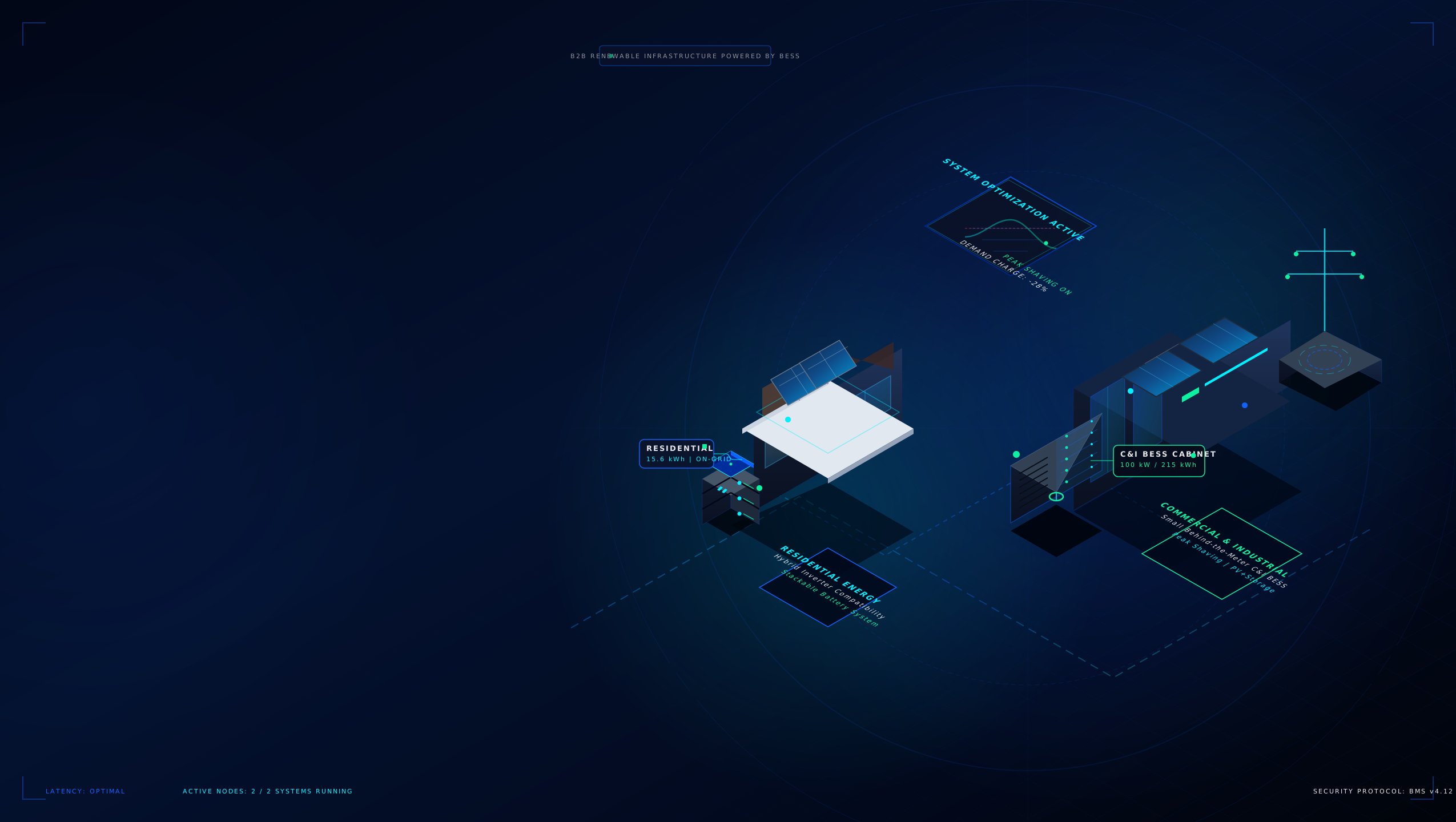
Conventional solar setups pair separate PV and battery units assembled from different vendors — creating efficiency gaps, integration conflicts, and unclear accountability. RAKOUR's solar battery storage solution natively combines LiFePO4 high-voltage battery modules with BCU control and inverter communication in a single coordinated architecture, eliminating unnecessary conversion losses from the start.
Why High Voltage Changes the Integration Equation

Operating between 232V and 979.2V, RAKOUR HV systems support far higher DC bus voltages than standard 48V alternatives. This translates directly into lower cable losses, reduced current draw, and better compatibility with commercial-scale hybrid inverters. The result is a battery energy storage system engineered for real project performance, not just specification-sheet numbers.

Who This Solution Is Designed For

RAKOUR's integrated platform targets commercial and industrial buyers: EPC contractors, system integrators, and distributors who need a verified, CE-certified system — not individual components requiring field-level compatibility testing. One manufacturer, one BMS protocol, one warranty scope.

How a Hybrid Solar System Delivers Continuous Power

Understanding the DC-coupled energy flow from PV generation to load dispatch

From Solar Panels to High-Voltage DC Bus

RAKOUR's architecture uses DC coupling to charge battery modules directly from PV strings without an intermediate AC conversion step. The BCU coordinates voltage matching between the PV input and the series-connected modules. This approach — characteristic of a well-designed hybrid solar system — preserves 3–5% more energy per cycle compared to AC-coupled alternatives where two conversion stages occur.

How the BCU and BMS Coordinate Energy Dispatch

The Battery Control Unit manages series module strings while each module's slave BMS monitors cell voltage, current, and temperature in real time. CAN or RS485 communication links the BCU to the inverter, enabling intelligent charge/discharge scheduling. Soft-start circuitry built into RAKOUR HV units allows compatibility even with inverters that lack native soft-start — reducing integration friction for installers.

Grid Interaction: On-Grid, Off-Grid, and Seamless Switching

RAKOUR systems support TOU-based scheduling, on-grid self-consumption, and off-grid backup within a single configuration. Switching between modes requires no hardware reconfiguration — the hybrid solar power inverter handles transition logic while the BCU maintains battery state awareness throughout, ensuring zero interruption to critical loads.

High Voltage Battery Specs Built for Commercial Deployment

Verified parameters across RAKOUR's HV product line — no estimated figures

Voltage Platform and Energy Capacity Range

RAKOUR HV systems scale from 5 to 17 series modules per string, producing nominal voltages from 256V to 716.8V and total energy from 80.38 kWh up to 225.08 kWh per string. Each 51.2V314Ah module delivers 16.08 kWh. The high voltage battery architecture supports up to 4 strings in parallel, reaching combined capacities exceeding 900 kWh for larger C&I installations. Usable energy at 90% DoD is confirmed in datasheet testing — not estimated under ideal conditions.

Cell Chemistry, Cycle Life, and Certifications

All RAKOUR HV modules use LiFePO4 chemistry — inherently more thermally stable than NMC alternatives. Cycle life reaches ≥8,000 cycles for the 314Ah series, with a 5+5 year warranty structure. Certifications include CE, UN38.3, and MSDS, meeting international shipping and installation requirements. Operating temperature for discharge spans −20°C to 60°C.

Communication and Monitoring Interfaces

Each system provides CAN, RS485, and built-in Wi-Fi. The external touch screen displays real-time SOC, voltage, and fault codes. Remote monitoring via mobile app removes the need for on-site diagnostics during normal operation, reducing service costs for installers managing multiple sites.

Commercial Solar System Battery Products for Real-World Applications

Where RAKOUR HV solar battery storage delivers measurable project value

Peak Shaving and TOU Optimization for C&I Facilities

Factories and commercial buildings pay the highest electricity rates during peak demand windows. RAKOUR's solar battery storage system stores midday PV generation and discharges during peak tariff periods, directly reducing demand charges. The BCU supports six programmable charge/discharge time slots per day, giving energy managers granular control aligned with local utility rate structures without additional software.

Microgrid and Off-Grid Power Supply

For sites beyond reliable grid reach — remote factories, telecom bases, agricultural facilities — RAKOUR HV systems operate fully off-grid. With up to 225 kWh per string and parallel expansion available, the system sustains heavy continuous loads. Diesel generator integration is supported, with the BCU coordinating generator start/stop based on battery SOC thresholds to minimize fuel consumption.

Backup Power for Critical Commercial Loads

Data rooms, medical facilities, and manufacturing lines cannot tolerate power interruptions. RAKOUR HV units provide seamless backup switching, keeping protected circuits live during outages. Paired with commercial solar system battery products from a single verified source, EPC contractors eliminate multi-vendor compatibility risks — delivering a simpler commissioning process and a cleaner warranty chain to end customers.

Hybrid Solar Inverters: Verified Compatibility with RAKOUR HV Systems

What installers need to know before connecting batteries to your inverter

Confirmed Inverter Models and Connection Architecture

RAKOUR 51.2V314Ah-HV has been field-verified with Deye SUN-29.9K~50KSG01HP3 and SUN-80K-SG02HP3-EU-EM6 series inverters. For Deye 80KW models supporting dual battery ports, RAKOUR recommends parallel shunting — connecting P1+/P1− to BAT1 and P2+/P2− to BAT2 — to increase output power without adding a second battery string. This reduces system cost while maximizing discharge capacity per inverter.

CAN/RS485 Communication Setup

The BCU CAN port connects directly to the inverter's BMS1 port using a standard RJ45 cable. Set the inverter battery mode to Lithium and enable "Parallel bat1&bat2" in the setup menu. The lifepo4 battery management system then communicates charging voltage, discharge cut-off voltage, and current limits automatically — no manual parameter entry required after initial configuration.

Soft-Start Compatibility and Multi-Protocol Support

RAKOUR HV units include an internal soft-start circuit, enabling compatibility with hybrid solar inverters that lack native soft-start functions. The BCU also supports RS485 alongside CAN, and communication protocols are switchable via the touch screen — important for installers working across inverter brands beyond the Deye range.

LiFePO4 Battery Management System: Three-Layer Protection Architecture

How RAKOUR ensures safe operation across cell, module, and system levels

Cell-Level Stability: Why LiFePO4 Chemistry Matters

RAKOUR HV modules use lithium iron phosphate cells — a chemistry that resists thermal runaway at significantly higher temperatures than NMC alternatives. Cell-level voltage is monitored continuously by each module's slave BMS. If any single cell exceeds 3.6V during charging, protection activates immediately, stopping the charge cycle before thermal stress accumulates. This cell-level response is the first line of defence in RAKOUR's layered safety architecture.

Module-Level Protection: Automatic Response to Six Fault Conditions

The bms battery management system embedded in each RAKOUR module monitors for six active fault conditions: overcharge, over-discharge, overcurrent (>200A), high temperature (>60°C charge cutoff), low temperature (<0°C charge block, −20°C discharge block), and overvoltage. Protection triggers automatically without inverter intervention, isolating the affected module while keeping the remainder of the string operational where possible.

System-Level BCU Control and Fan Cooling

At system level, the BCU integrates a DC fuse, cut-off protection switch, and a 24VDC power module. Each battery module includes a dedicated cooling fan plus perforated sheet metal panels to actively manage thermal load during continuous high-current discharge. Real-time fault codes appear on the external touch screen, enabling rapid on-site diagnosis without specialist equipment.

How to Size Your Solar Battery Storage Capacity for C&I Projects

A practical framework for selecting the right RAKOUR HV configuration

Understanding the Module-to-System Scaling Logic

Each RAKOUR 51.2V314Ah-HV module delivers 16.08 kWh. A single string supports 5 to 17 modules in series — spanning 80.38 kWh to 225.08 kWh at nominal voltage levels from 256V to 716.8V. Up to 4 strings can operate in parallel within one system, enabling combined capacities approaching 900 kWh from a single BCU-managed installation. This graduated structure lets integrators right-size every project without over-specifying hardware or compromising on future headroom.

Matching Capacity to Daily Load and Backup Duration

Calculate daily energy demand, then divide by DoD (90% for RAKOUR HV) to find required nominal capacity. A 200 kWh daily consumption requiring 8 hours of backup needs approximately 225 kWh nominal — achievable with a single 14-module HV-225K string. For solar battery storage projects with high peak-demand variability, an additional parallel string provides discharge power buffer without increasing voltage-level complexity.

Expanding Capacity After Initial Deployment

RAKOUR's rack-based architecture supports field expansion. Adding modules to an existing string requires matching battery production dates within 12 months and voltage differences within 1V before connection. The server rack battery backup format means modules slot into existing cabinet structures — no new enclosures required for capacity upgrades up to the 17-module string maximum.

Step-by-Step Guide to Installing and Commissioning RAKOUR HV Battery Systems

What to verify before power-on, and how to maintain system performance long-term

Pre-Installation Checks and Mechanical Assembly

Before installation, inspect all packaging for transport damage and verify accessory completeness against the packing list. RAKOUR HV systems use a stacked sheet-metal frame: assemble the load-bearing base first, install battery modules from bottom to top aligning each limiting latch, then mount the BCU at top. After mechanical assembly, keep 300mm clearance around the cabinet for ventilation. The mounting surface must be fire-resistant and correctly earthed before any electrical connection begins.

Power Cable and Communication Line Sequencing

Connect power cables first — positive and negative terminals from BCU (P1+/P1−) to the inverter BAT port. Then connect the CAN communication cable from BCU to the inverter BMS port. For parallel strings, verify that voltage difference between any two strings is within 1V before bridging them. Set each module's dip-switch BMS address sequentially: host battery at address 1, slave modules numbered 2 onward. First power-on should run a full charge cycle to balance cell capacity across all modules.

Routine Maintenance and Long-Term Storage Requirements

RAKOUR HV systems require minimal scheduled maintenance: inspect fan operation every six months, check terminal torque annually, and clear ventilation paths regularly. For extended storage, maintain SOC between 30% and 60% and keep ambient temperature below 25°C for storage exceeding three months. If batteries have been over-discharged, recharge within 15 days at ambient temperatures below 25°C to prevent cell damage.

Frequently Asked Questions About RAKOUR Solar Battery Storage Systems

Find answers to common technical and purchasing questions about RAKOUR high voltage solar storage.

What hybrid solar inverters are compatible with the RAKOUR HV battery system?

RAKOUR HV is verified with Deye SUN-29.9K~50K and SUN-80K series inverters. Any inverter supporting CAN or RS485 BMS communication is compatible. Contact RAKOUR to confirm your specific inverter model before ordering.

How does the lifepo4 battery management system protect the battery during operation?

RAKOUR's BMS monitors overcharge, over-discharge, overcurrent, and temperature per module. Protection activates automatically, isolating faults instantly. All codes display on the touch screen for quick on-site diagnosis.

What is the maximum capacity of a RAKOUR high voltage battery energy storage system?

A single string scales from 80 to 225 kWh using 5 to 17 modules. Up to 4 strings can operate in parallel, enabling combined system capacity near 900 kWh from a single BCU-managed installation.

What certifications do RAKOUR battery storage systems carry for international projects?

RAKOUR HV systems are CE, UN38.3, and MSDS certified. Select LV models also carry IEC62619 and ROHS. All certifications meet international installation and safety requirements for C&I solar storage projects.

How long does the battery storage system warranty last and what does it cover?

RAKOUR HV batteries carry a 5+5 year warranty covering the full system and cells. It includes manufacturing defects, abnormal capacity loss, and BMS faults under standard documented operating conditions.

Ready to Build Your Solar Battery Storage System with RAKOUR?

Ready to Build Your Solar Battery Storage System with RAKOUR?

Tell us your project capacity, inverter model, and application — we'll configure the right HV solution for you.